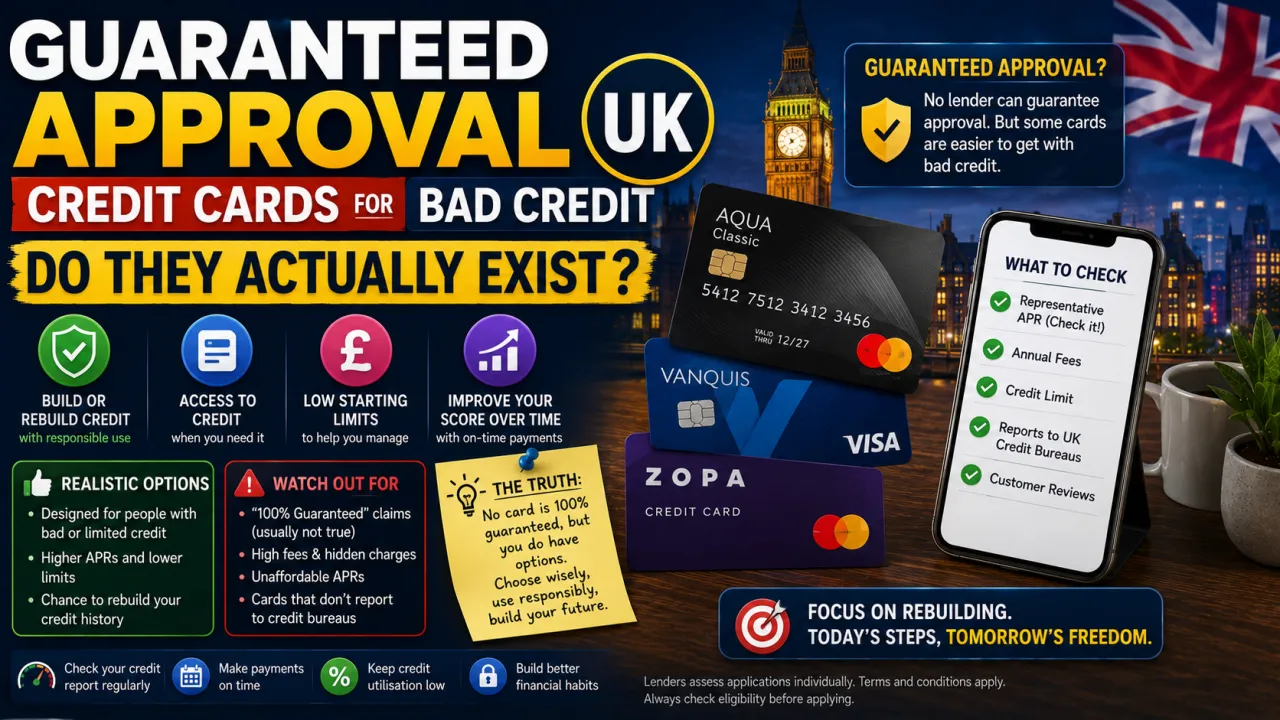
If you've been searching for a "guaranteed approval" credit card, you've probably noticed something odd: every comparison site promises one, but the small print on every single card still says "subject to status." That's not an accident. It's the whole story.
Here's the honest answer before we go any further: no UK credit card offers 100% guaranteed approval. Every lender that offers credit in this country is legally required to run some form of affordability and credit check under FCA rules. Anyone advertising a card with zero checks and guaranteed acceptance is either mis-selling, describing a prepaid card dressed up as credit, or running a scam.
That doesn't mean you're out of options. It means you need to understand what "guaranteed approval" actually refers to in the credit card industry — and which cards genuinely have the highest acceptance rates for people with poor or thin credit files.
Why "Guaranteed Approval" Is a Marketing Phrase, Not a Legal One
In the UK, every regulated credit product has to go through:
- A soft or hard credit check (soft checks don't affect your score; hard checks do and are visible to other lenders)
- An affordability assessment, which looks at your income against your existing debt
- Identity and residency verification
Because of this, "guaranteed approval" as used in ads almost always means one of three things:
- High-acceptance cards designed specifically for bad credit, with acceptance rates in the 70–90% range for eligible applicants
- Cards with an eligibility checker that uses a soft search first, so you know your odds before a hard search touches your file
- Credit-builder cards where the "guarantee" is really about a low, easily-met bar — not zero risk assessment
If you see a card claiming truly guaranteed approval with no checks at all, treat it as a red flag. It's often an unregulated lender, a high-cost credit product, or a card issued outside FCA oversight.
Cards That Come Closest to "Guaranteed" in the UK
These aren't official rankings from any lender — they're the categories of cards that consistently show the highest approval rates for bad credit applicants, based on how they're built.
1. Credit-Builder Cards with Soft-Search Eligibility Checkers
Cards designed specifically for credit building (rather than rewards or cashback) typically accept a wider range of applicants because the business model relies on charging a higher APR, not on lending only to prime borrowers. Look for cards that let you check your eligibility with a soft search before applying — this is the single most reliable way to avoid a wasted hard search on your file.
2. Cards Aimed at Thin-File or Newly Arrived Applicants
If your issue is a short credit history rather than missed payments (for example, you've recently moved to the UK or are applying for your first card), some issuers specifically underwrite for this group and have noticeably higher acceptance rates.
3. Secured or Deposit-Backed Cards
Not common in the UK compared to the US, but a small number of providers offer cards backed by a refundable deposit. Because the lender's risk is covered by your deposit, approval odds are close to automatic — though this isn't the same as "no credit check."
For a full breakdown of every card type available, see our full comparison of bad credit credit cards in the UK.
What Actually Gets You Approved (Even With Bad Credit)
Approval odds come down to a handful of controllable factors:
- Check your eligibility before applying. A soft-search eligibility checker takes two minutes and won't touch your credit score. Skipping this step and applying blind is the number one reason people get declined and then damage their score further.
- Register on the electoral roll. Lenders use this to verify your identity and address. Being off the roll is a surprisingly common, surprisingly fixable reason for automatic declines.
- Close old, unused credit accounts. Multiple open credit lines — even ones you're not using — can hurt your affordability assessment.
- Space out applications. Multiple hard searches in a short window signals risk to lenders. Wait at least 3 months between applications where possible.
- Apply for the right tier of card. Applying for a mainstream rewards card with poor credit is almost guaranteed to fail. Applying for a card actually built for your credit profile dramatically improves your odds.
Red Flags to Avoid
- Any site asking for an upfront "processing fee" before you're even approved
- Cards that don't report to the three main UK credit reference agencies (Experian, Equifax, TransUnion) — if it doesn't report, it can't help rebuild your score
- Extremely high APRs disguised in small print (some poor-credit cards sit above 30% APR representative — always check before applying)
- Lenders not listed on the FCA register
The Bottom Line
There's no such thing as a UK credit card with zero checks and 100% guaranteed approval — but there are cards purpose-built for bad credit with genuinely high acceptance rates, especially when you use a soft-search eligibility checker first. Treat "guaranteed approval" as a signal to look closer, not a promise to take at face value.
Want to check your odds before applying? Try comparing offers with our credit card comparison guide.
Frequently Asked Questions
Q: Is there really a credit card in the UK with no credit check at all? No. Every FCA-regulated lender is required to carry out some form of credit and affordability check. A card advertising zero checks is either not properly regulated or not a genuine credit product.
Q: What's the difference between a soft search and a hard search? A soft search lets you check your eligibility without affecting your credit score or being visible to other lenders. A hard search happens when you formally apply, is recorded on your credit file, and can be seen by future lenders.
Q: Will applying for a bad credit card hurt my score? A hard search will cause a small, temporary dip. Multiple hard searches in a short period can do more lasting damage, which is why using a soft-search eligibility checker before applying is worth doing every time.
Q: Can I get a credit card with a CCJ or defaults on my file? Yes, in many cases. Bad credit and credit-builder cards are specifically designed for applicants with defaults, missed payments, or CCJs — though older, more severe, or unresolved CCJs can still lead to a decline depending on the lender's policy.
Q: How long does it take to rebuild credit with one of these cards? Most people see measurable improvement within 3–6 months of consistent on-time repayment, provided the card reports to the credit reference agencies and the balance is kept low relative to the limit.
Q: Are guaranteed approval cards a scam? Not always, but the phrase itself is a marketing red flag. Legitimate high-acceptance cards exist; genuinely "guaranteed, no checks" products usually are not legitimate regulated credit.

The Editorial Team
We are a collective of tech enthusiasts and digital experts dedicated to making sense of the evolving digital landscape for our global audience.
Connect With Us

0 Perspectives