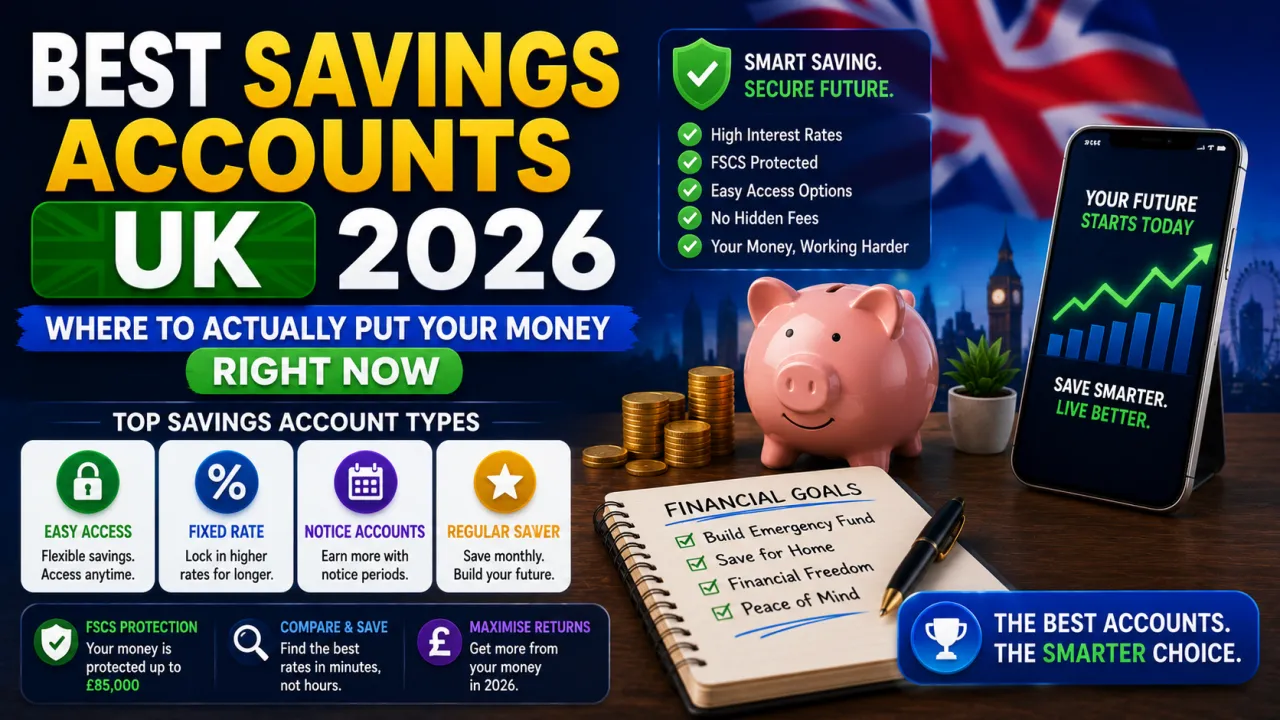
If you've got money sitting in a current account earning next to nothing, you're not alone — but you are leaving money on the table. With interest rates still at levels we haven't seen in over a decade, 2026 is genuinely one of the better times to be a UK saver. The trick is knowing where to put your cash.
This guide cuts through the noise and tells you exactly which types of savings accounts are worth your attention right now, what to look for, and which ones are best suited for different situations.
Why Your Current Account Is Not Enough
Most UK current accounts pay 0% to 0.5% interest at best. With inflation still nibbling away at purchasing power, keeping your savings in a current account is essentially a slow leak. A dedicated savings account — even a basic easy-access one — can pay significantly more, sometimes 4% to 5% AER depending on the provider.
The good news: opening a savings account in the UK is quick, often done entirely online, and your money is protected up to £85,000 per institution under the Financial Services Compensation Scheme (FSCS).
Types of Savings Accounts in the UK
Before picking an account, it helps to understand what's available:
Easy-Access Savings Accounts You can deposit and withdraw whenever you like. These offer flexibility but slightly lower rates than accounts that lock your money away. Ideal if you're building an emergency fund or might need the cash at short notice.
Fixed-Rate Savings Accounts (Fixed-Term Bonds) You lock your money away for a set period — typically 1, 2, or 3 years — in exchange for a higher interest rate. The catch is you usually can't access the money before the term ends without a penalty. Best for money you know you won't need.
Cash ISAs A Cash ISA is a savings account where interest is earned tax-free. Every UK adult gets an ISA allowance of £20,000 per tax year. If you're a higher-rate taxpayer or have significant savings, a Cash ISA can save you real money on tax. Rates are competitive with standard savings accounts.
Regular Savings Accounts These require you to deposit a set amount each month (for example, £25 to £250) and often offer the highest headline rates. The catch is that if you miss a payment or withdraw early, you typically lose the bonus rate.
Notice Accounts A middle ground between easy-access and fixed-rate. You can withdraw, but you must give notice — usually 30, 60, or 90 days. Rates sit between easy-access and fixed-rate accounts.
What Makes a Good Savings Account in 2026?
When comparing accounts, focus on these factors:
- AER (Annual Equivalent Rate): This is the standardised way interest rates are quoted in the UK. Always compare AER, not monthly rates.
- FSCS protection: Only save with institutions covered by the FSCS. Most UK banks and building societies are.
- Access terms: Be honest with yourself about whether you'll need the money. A higher rate means nothing if you have to break the term early and lose interest.
- Introductory bonuses: Some accounts boost rates with a short-term bonus that drops after 12 months. Fine to use, but set a reminder to switch.
- App and online access: If you prefer managing everything digitally, check the provider's app reviews before committing.
Who Offers the Best Rates Right Now?
Rather than listing specific rates that will change month to month, here's where competitive rates consistently appear in the UK:
Challenger banks and online providers — Banks like Marcus (Goldman Sachs), Chip, and Atom Bank have consistently offered higher easy-access rates than the high street. They operate with lower overheads and pass savings on to customers.
Building societies — Coventry, Nationwide, and Yorkshire Building Society regularly appear at the top of savings rate tables, particularly for fixed-rate bonds and Cash ISAs.
High street banks — Barclays, Lloyds, HSBC, and NatWest typically offer lower rates but come with convenience if you already bank with them. They occasionally run competitive deals, especially for existing customers.
Comparison tools — MoneySavingExpert's savings section and Moneyfacts update rates daily. Check these before opening any account.
How Much Should You Keep in Savings?
A useful benchmark: keep three to six months of essential expenses in an easy-access savings account as your emergency fund. This covers job loss, unexpected repairs, or medical costs without forcing you into debt.
Beyond that, split your savings based on when you'll need the money:
- Short-term (under 1 year): Easy-access or short notice account
- Medium-term (1–3 years): Fixed-rate bond
- Long-term (3+ years): Consider a Stocks and Shares ISA alongside a Cash ISA — historically, investing beats cash over long time horizons
Don't Forget the Personal Savings Allowance
Basic rate taxpayers can earn up to £1,000 in savings interest per year without paying tax. Higher rate taxpayers get a £500 allowance. If you're earning more than this in interest — which is increasingly possible with higher rates and larger balances — a Cash ISA becomes more valuable since all interest inside an ISA is tax-free, regardless of amount.
The Bottom Line
The best savings account in the UK in 2026 depends on your situation. If you need flexibility, go easy-access and pick a challenger bank or building society. If you have money you won't touch for a year or more, a fixed-rate bond will pay you more. And if you're a higher earner with significant savings, max your ISA allowance first every tax year.
The most important step is simply to move your money off the shelf. Even switching to an average easy-access savings account will earn you more than leaving cash in a current account. Start there, then optimise.

The Editorial Team
We are a collective of tech enthusiasts and digital experts dedicated to making sense of the evolving digital landscape for our global audience.
Connect With Us

0 Perspectives