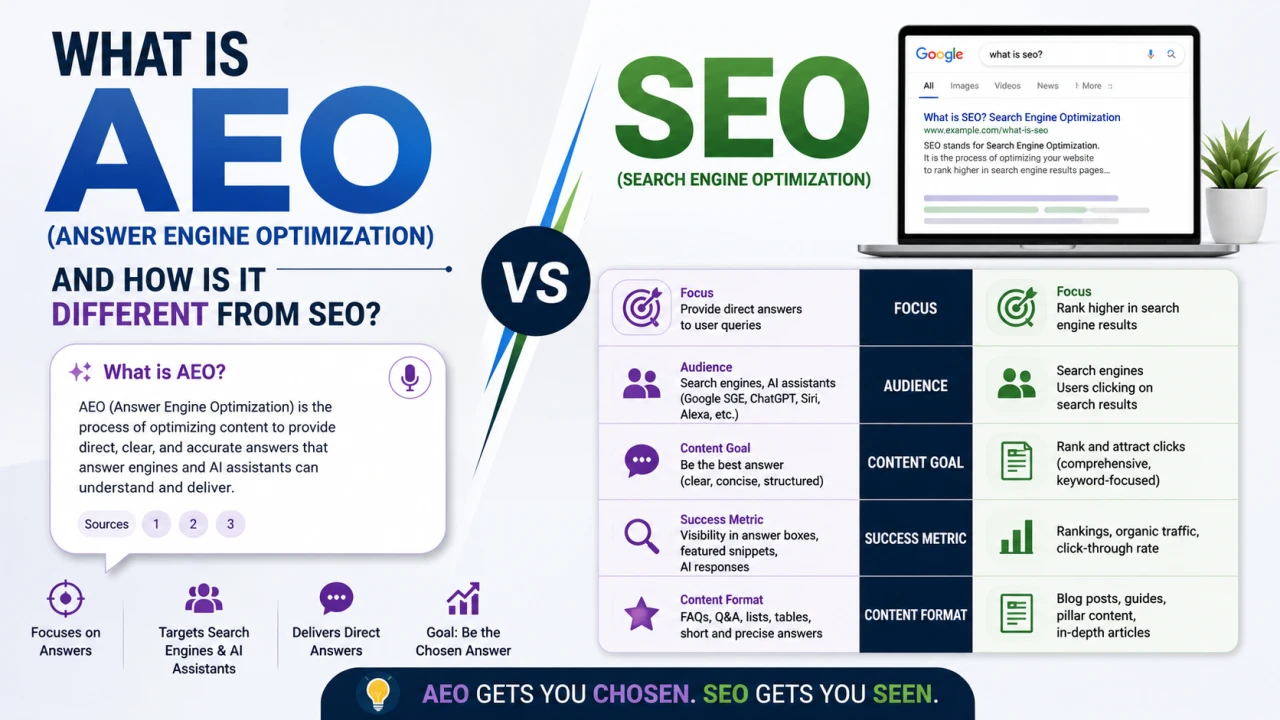
Search behaviour has quietly split into two paths. One is still typing a query into Google and clicking a blue link. The other is asking ChatGPT, Perplexity, or Google's AI Overviews a question and reading a synthesized answer without ever visiting a website. AEO — Answer Engine Optimization — is the practice of making your content more likely to be the source an AI system pulls from and cites when it generates that answer.
It's not a replacement for SEO. It's a parallel discipline that's becoming impossible to ignore.
AEO vs. SEO: The Core Difference
Traditional SEO optimizes for ranking — getting your page to appear as high as possible in a list of search results, competing on relevance and authority signals for a click.
AEO optimizes for being the source of an answer — getting your content selected, summarized, and cited (or used without citation) by an AI system that's generating a direct response to a user's question, often without the user ever seeing a list of links at all.
| SEO | AEO | |
|---|---|---|
| Goal | Rank high, earn a click | Get cited or used as a source in an AI-generated answer |
| Success metric | Position, click-through rate, organic traffic | Citation frequency, brand mentions in AI answers, referral traffic from AI tools |
| Content structure | Optimized for scanning and ranking signals | Optimized for extractable, self-contained answers |
| User outcome | Visits your site | May never visit your site, but sees your brand/answer |
Both matter. Traditional search isn't disappearing, but a growing share of queries — especially informational ones — are being answered directly by AI systems before a user ever reaches a search results page.
Why This Matters Now
Google's AI Overviews already appear above traditional results for a large share of informational searches. Tools like ChatGPT, Perplexity, and Claude are increasingly used as a first stop for research and quick answers instead of a search engine. For publishers and businesses, this means visibility can now happen without a click — your brand or content gets referenced in an AI answer, which builds awareness even without direct traffic, but only if the AI system is actually drawing from your content in the first place.
How AI Answer Engines Choose Sources
While each system works differently, a few consistent patterns show up across AI Overviews, Perplexity, and similar tools:
- Clear, direct answers rank higher for extraction. Content that states a clear answer early, rather than building up to it through a long narrative, is easier for an AI system to pull and cite accurately.
- Structured content is favoured. Headers, bullet points, tables, and well-organized FAQ sections are easier for these systems to parse and extract from than dense, unbroken paragraphs.
- Authoritative, well-sourced content is preferred, similar to traditional SEO — AI systems generally still lean on established E-E-A-T-style signals (Experience, Expertise, Authoritativeness, Trustworthiness).
- Fresh, specific, and original content performs better than generic summaries that just restate what's already widely available elsewhere.
Practical Steps to Optimize for AEO
1. Answer the Question Directly, Early
Don't bury the actual answer three paragraphs into a post. Lead with a clear, concise answer to the core question in the first 1-2 sentences of a section, then expand with supporting detail.
2. Use Structured Formatting Deliberately
Headers that mirror how people actually phrase questions ("What is X?", "How do I fix Y?"), bullet points for lists, and tables for comparisons all make content more extractable — both for AI systems and for readers scanning quickly.
3. Build Genuine FAQ Sections
FAQ sections formatted with clear questions and direct answers are consistently well-suited to AI extraction, since they already mirror the question-and-answer format these systems are generating.
4. Include Specific, Original Detail
Generic, widely-repeated information is easy for an AI system to source from anywhere. Original data, specific examples, first-hand experience, or a genuinely distinct angle makes your content a more valuable, differentiated source worth citing specifically.
5. Maintain Strong Traditional SEO Fundamentals
AEO doesn't replace the fundamentals — clean site structure, fast load times, mobile usability, and solid on-page SEO all still influence whether your content gets crawled, indexed, and considered as a potential source in the first place.
6. Track Citations, Not Just Rankings
Traditional rank tracking doesn't capture AEO performance. Periodically test your target queries directly in ChatGPT, Perplexity, and Google's AI Overviews to see whether your content is being referenced, and adjust based on what competing sources are doing differently.
The Honest Limitations of AEO Right Now
AEO is still an emerging discipline without the mature tooling and measurement standards SEO has built up over two decades. There's no universal "AEO rank tracker" equivalent to traditional rank tracking tools, citation behaviour varies across different AI systems and can change without notice, and there's ongoing debate about whether AI-driven visibility reliably converts to business value the way a traditional organic click does. Treat AEO as a genuinely important emerging practice, not a fully solved formula yet.
The Bottom Line
AEO isn't a replacement for SEO — it's an additional layer built on many of the same foundations, adapted for a search landscape where a growing share of queries get answered directly by AI before a user ever sees a results page. The practical response is straightforward: keep your SEO fundamentals strong, and layer in clearer, more extractable, more structured content on top of it.
Frequently Asked Questions
Q: Is AEO going to replace SEO entirely? Unlikely in the near term. Traditional search still drives significant traffic, and many of the fundamentals that support SEO — site quality, authority, structure — also support AEO. The two are increasingly complementary rather than competing.
Q: Can I track how often AI systems cite my content? Not yet through a single standardized tool the way you can track search rankings. The most reliable current approach is manually testing your target queries directly in tools like ChatGPT, Perplexity, and Google's AI Overviews.
Q: Does structured content really help with AEO? Yes — clear headers, bullet points, tables, and direct answers are generally easier for AI systems to extract and cite accurately than long, unstructured paragraphs, based on observed patterns across major AI answer engines.
Q: Will AEO reduce my website traffic since users get answers without clicking? It's a real risk for some purely informational queries. The counterbalance is that being cited as a source can build brand visibility and trust even without a click, and users seeking deeper detail than a summary provides will often still click through.
Q: Do I need to write differently for AEO than for regular readers? Not fundamentally — clear, direct, well-structured writing benefits both human readers and AI extraction. The main adjustment is leading with direct answers earlier and using more deliberate formatting (headers, FAQs, tables) than you might in narrative-style writing.
Q: Is AEO the same as "Generative Engine Optimization" (GEO)? They're closely related terms often used interchangeably, both referring to optimizing content for AI-generated answers rather than traditional ranked search results. Some practitioners draw minor distinctions, but the core practices largely overlap.

The Editorial Team
We are a collective of tech enthusiasts and digital experts dedicated to making sense of the evolving digital landscape for our global audience.
Connect With Us

0 Perspectives