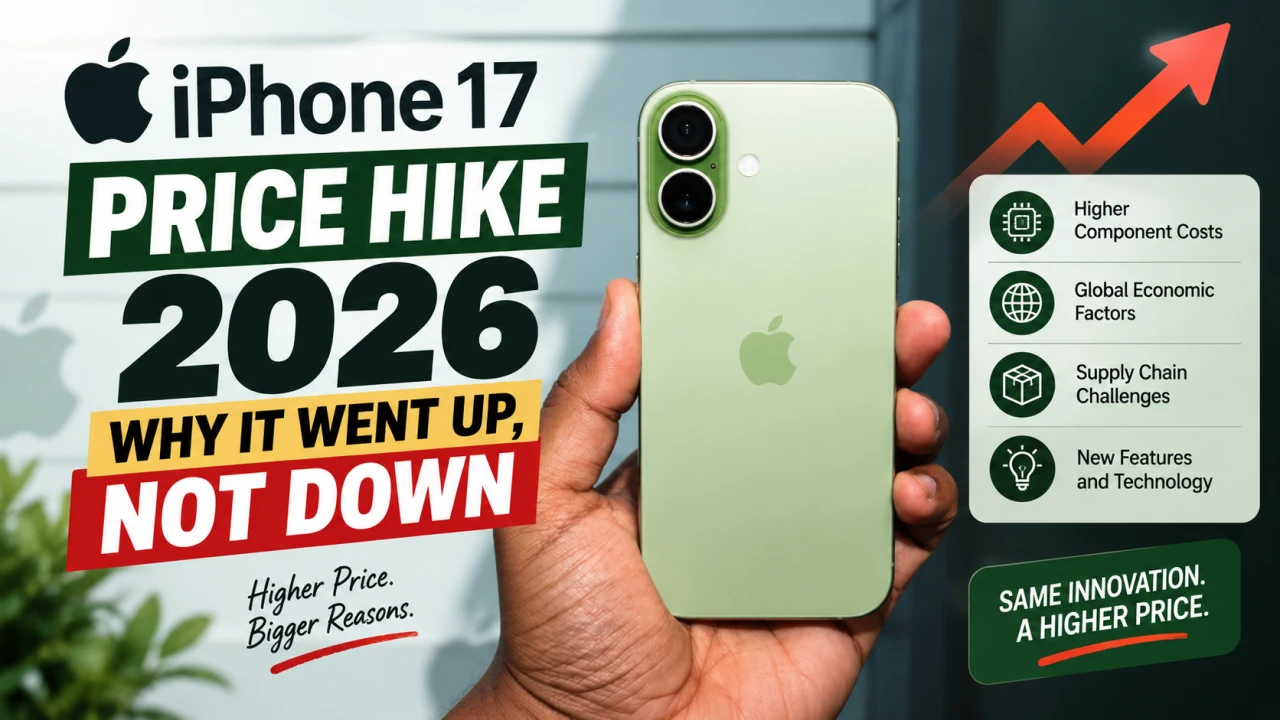
For as long as most people have been buying iPhones, one rule has held steady: when Apple launches a new iPhone, last year's model gets cheaper. It's the moment bargain hunters wait for every September — the new flagship arrives, and the previous generation quietly drops in price to make room for it.
This year, that didn't happen. On September 9, 2026 — the exact same day Apple unveiled the iPhone 18 Pro and its first-ever foldable iPhone — the iPhone 17 got more expensive, not less. If you've been holding off on a purchase waiting for the usual post-launch discount, here's what actually happened and why.
What Changed, Exactly
Apple quietly repriced its existing iPhone lineup on the same day as the iPhone 18 Pro announcement:
- iPhone 17: $799 → $899 (a $100 increase)
- iPhone Air: $999 → $1,099 (a $100 increase)
- iPhone 17e: also increased from its $599 launch price
Meanwhile, the iPhone 17 Pro and iPhone 17 Pro Max were discontinued entirely rather than repriced — Apple simply pulled them from sale instead of raising their prices further, since the new iPhone 18 Pro line was taking over that slot in the catalogue anyway.
To make the timing even more unusual, several retailers had actually been discounting the iPhone 17 lineup in the days immediately before the event, as stores raced to clear stock ahead of the new launch. Buyers who purchased in that narrow window ended up with the best deal of the entire cycle, entirely by accident of timing.
Why This Breaks a 15-Year-Old Pattern
Go back through nearly every iPhone launch of the past decade, and the pattern is consistent: new flagship arrives, previous year's phone drops by $100-$200, and that discounted older model becomes the new "budget" option in Apple's lineup. Last September, for example, the iPhone 16 and iPhone 16 Plus both dropped $100 when the iPhone 17 launched.
This year, Apple needed the iPhone 17 to keep functioning as the mid-tier option in its lineup for an unusually long stretch — the standard iPhone 18 isn't arriving until spring 2027, meaning the iPhone 17 has to hold that position for another six months rather than being replaced immediately. Combined with rising internal costs, Apple made the unusual call to raise its price instead of cutting it, rather than sell it at a loss for half a year.
The Real Reason: A Global Memory Chip Shortage
This isn't Apple simply testing what it can get away with — the underlying cause is an industry-wide supply problem that's been building for months, one that's already hit other major tech companies.
The shortage has been informally dubbed "RAMageddon." Here's what's driving it:
- AI infrastructure is consuming the world's memory chip supply. The massive buildout of AI data centers has pulled DRAM and NAND flash production away from consumer electronics and toward server-grade memory, creating a supply crunch across the entire tech industry.
- The numbers are extreme. According to Counterpoint Research, smartphone memory prices jumped more than 80% in a single quarter this year. DRAM prices are up roughly 400% year-over-year, and NAND flash prices have climbed more than 300%.
- Apple isn't alone. Samsung, Microsoft, Sony, and Dell have all raised prices on various products in 2026 citing the same memory cost pressures.
- Apple's CEO addressed it directly. In comments to The Wall Street Journal earlier this year, Apple's leadership described the memory shortage as something not seen in decades, comparing it to a "hundred-year flood" in terms of scale and rarity.
Apple had already raised prices on Macs and iPads back in June for the same reason. The iPhone was notably left out of that round of increases — until now.
Why the iPhone 17 Pro and Pro Max Were Discontinued, Not Hiked
It's worth noting the different treatment here. The standard iPhone 17 and iPhone Air got price increases because Apple needs them to remain on sale as the mid-range option for the next several months. The iPhone 17 Pro and Pro Max, on the other hand, were discontinued outright the same day the iPhone 18 Pro launched — their job in the lineup was already done, so there was no reason to keep them around at a higher price when a direct replacement was ready.
What This Means If You're Buying Now
If you were waiting for a post-launch discount on the iPhone 17: that discount isn't coming this cycle. The calculation has flipped — the iPhone 17 is now more expensive than it was a week ago, not less.
If you already own an iPhone 17 or 17 Pro and were considering selling it: value on used and trade-in iPhone 17 Pro models is expected to fall meaningfully now that the line is discontinued and a direct successor exists. If you're planning to sell, doing so sooner rather than later typically preserves more resale value.
If you're deciding between the iPhone 17 (now $899) and the iPhone 18 Pro (from $1,199): the price gap between the standard iPhone 17 and the Pro line has narrowed noticeably compared to previous years, which may make stretching to the Pro tier more tempting than it would have been a year ago.
If budget is the priority: a refurbished iPhone 17 Pro, now that the line is discontinued, may become one of the better value options over the next few months as retailers and certified refurbishers work through remaining stock. Stick to manufacturer-certified or major-retailer-certified refurbished listings, confirm the battery health percentage before buying, and check the warranty length — the same due-diligence rules that apply to any refurbished electronics purchase apply here too.
The Bottom Line
The iPhone 17 price increase isn't a case of Apple quietly testing higher prices because it can — it's a direct pass-through of a genuine, industry-wide memory chip shortage that's already forced similar price increases at Samsung, Microsoft, Sony, and Dell. The unusual part isn't that prices went up; it's that they went up on last year's phone at the exact moment a new one arrived, breaking a pattern that's held for well over a decade. If you were counting on the usual post-launch discount, it's worth adjusting your expectations and your budget accordingly.
Frequently Asked Questions
Q: Did Apple raise iPhone 18 Pro prices too, or just the iPhone 17? Both went up. The iPhone 18 Pro launched at $1,199, a $100 increase over the iPhone 17 Pro's $1,099 starting price, on top of the separate iPhone 17 price increase announced the same day.
Q: Will iPhone 17 prices drop again later this year? There's no confirmation either way. Given that the standard iPhone 18 isn't arriving until spring 2027, the iPhone 17 will likely need to remain Apple's mid-tier option for several more months, which makes a near-term price drop less certain than in a typical year.
Q: Is the memory chip shortage expected to end soon? Industry analysts have not given a clear end date. The shortage is tied to the scale of global AI infrastructure investment, which shows no sign of slowing, so elevated memory costs may persist through 2026 and potentially into 2027.
Q: Should I buy an iPhone 17 now or wait? If you need a phone now, waiting is unlikely to help this cycle, since the usual post-launch discount didn't happen. If you can wait, monitoring retailer promotions (rather than Apple's own pricing) may still turn up temporary discounts even without an official price cut.
Q: What happened to the iPhone 17 Pro and Pro Max? Both were discontinued on September 9, 2026, the same day the iPhone 18 Pro and Pro Max launched, rather than being repriced. Once discontinued, remaining stock is typically sold through retailers and refurbishers at a discount over time.
Q: Are other phone brands raising prices too? Yes. Samsung, Microsoft, Sony, and Dell have all raised prices on various products in 2026, citing the same memory chip cost increases affecting the entire electronics industry.

The Editorial Team
We are a collective of tech enthusiasts and digital experts dedicated to making sense of the evolving digital landscape for our global audience.
Connect With Us

0 Perspectives