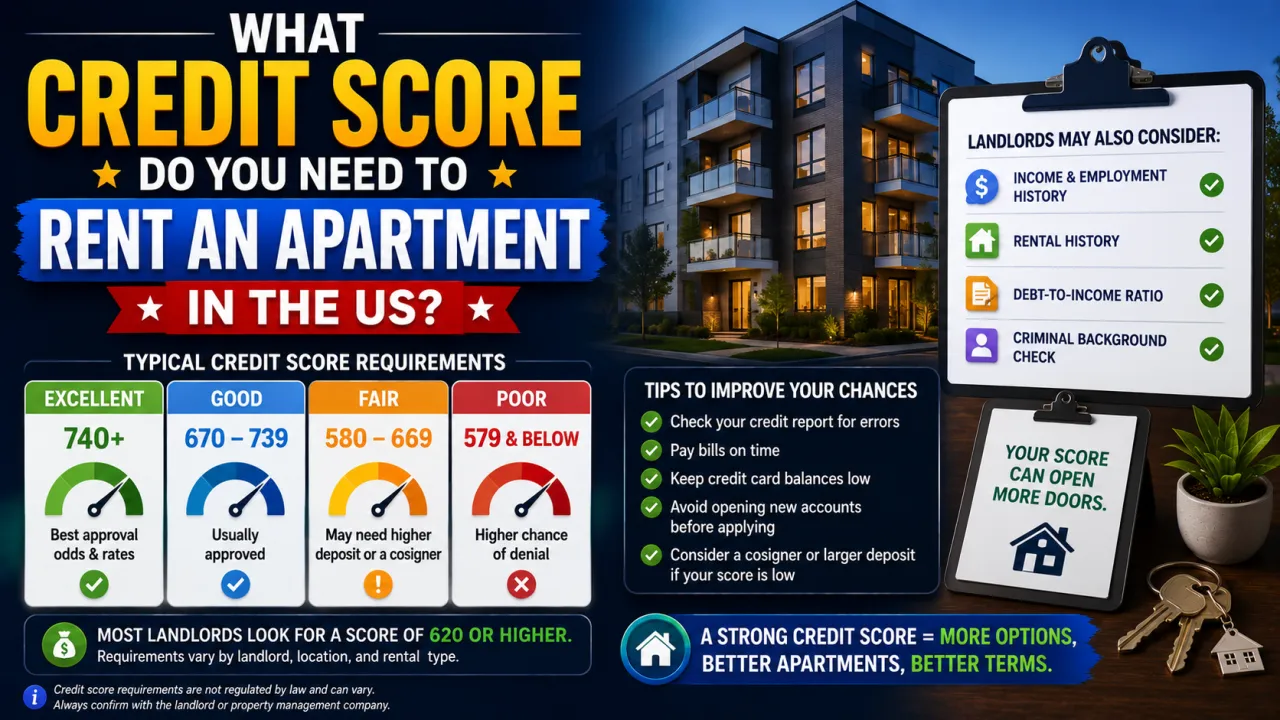
When you're apartment hunting in the United States, your credit score follows you. Most landlords and property management companies run a credit check as part of the application process, and a low score can lead to rejections — or force you into paying a larger deposit than you expected.
But the relationship between credit scores and renting is more nuanced than a single number pass-fail. Here's what landlords actually look at, what scores are typically needed in different markets, and what you can do if your credit isn't where you'd like it to be.
Do All Landlords Check Credit?
Most do, but not all. Large apartment complexes and property management companies almost universally run credit checks. Private individual landlords — someone renting out a spare room or a single property they own — are more variable. Some run credit checks through services like TransUnion SmartMove or RentSpree. Others rely more on references, income verification, and the impression you make in person.
In competitive rental markets like New York City, San Francisco, or Chicago, credit checks are nearly universal and standards are higher. In smaller markets or with private landlords, there's more flexibility.
What Credit Score Do Landlords Typically Want?
There's no single universal requirement — it varies by landlord, property, and location. But based on general industry practice:
700 and above — you'll have no issues in virtually any rental market. You're a low-risk applicant and most landlords will be happy to rent to you.
650 to 699 — generally acceptable to most landlords. You may face questions about specific items on your report but are unlikely to be declined on credit alone.
600 to 649 — you're in a grey area. Some landlords will accept this range, particularly if your income and rental history are strong. Others will decline. Expect to be asked for a larger security deposit in some cases.
Below 600 — you'll face more rejections, particularly from larger property management companies. Private landlords and more flexible housing options become more important at this range.
Keep in mind that credit score is just one part of what landlords evaluate. Income, rental history, employment status, and references all play a role.
What Else Do Landlords Look at Beyond Credit Score?
Income to rent ratio — most landlords want your gross monthly income to be at least two to three times the monthly rent. If rent is $1,500/month, a landlord typically wants to see income of $3,000 to $4,500/month. This is often as important as your credit score.
Rental history — have you rented before? Did you pay on time? Were you evicted? An eviction on your record is one of the most significant red flags for a landlord — often more damaging than a low credit score alone.
Employment status — landlords want to know you have stable income. A letter from your employer or recent pay stubs are commonly requested alongside your application.
Criminal background check — separate from the credit check, many landlords also run a criminal background check. Policies vary significantly by state and landlord.
References — a letter from a previous landlord confirming you paid on time and left the property in good condition can go a long way, especially if your credit score is marginal.
What Appears on a Rental Credit Check?
When a landlord runs a credit check, they typically see:
- Your credit score (usually from TransUnion or Experian)
- Your payment history — whether you've paid bills and debts on time
- Outstanding debt balances and credit utilisation
- Any collections accounts — particularly rent-related collections
- Bankruptcies
- Evictions (these appear on tenant screening reports, which are often run alongside or instead of a standard credit check)
They generally do not see your income, employment history, or specific purchase details.
How to Rent an Apartment With Bad Credit
Having bad credit doesn't automatically disqualify you. Here are approaches that genuinely work:
Offer a larger security deposit — many landlords will accept a larger upfront deposit (sometimes two to three months' rent instead of one) in exchange for overlooking a lower credit score. This reduces their risk. Always get any such arrangement in writing.
Get a co-signer — a co-signer with good credit agrees to be legally responsible for the rent if you default. This is commonly used by students, recent graduates, or anyone with a thin credit file. Note that your co-signer takes on real risk, so ask someone who trusts you and understands the commitment.
Show strong income — if your income is significantly above the typical requirement, lead with that. A higher income-to-rent ratio can offset credit concerns for some landlords.
Offer to pay multiple months upfront — some landlords will accept a few months' rent in advance in lieu of a strong credit score. This isn't always possible financially, but if you have savings and limited income history or credit, it can unlock options.
Look for private landlords — individual landlords who own one or a few properties are more likely to evaluate you as a person rather than run you through a rigid scoring system. They may care more about your references and conversation than your credit report.
Be transparent — if you know your credit isn't great, address it proactively in your application. Briefly explain what happened (job loss, medical bills, a period of financial hardship) and what's changed. Landlords appreciate honesty and it can make a difference with private owners.
Target flexible housing options — rooms in shared houses, rent-by-week options, or furnished short-term rentals often have less rigorous credit requirements. They can serve as a stepping stone while you build your credit.
How to Improve Your Credit Score Before Renting
If you're planning to move in three to six months, there are practical steps that can improve your score in that window:
Pay down credit card balances — reducing your credit utilisation ratio (the percentage of available credit you're using) can improve your score noticeably within one to two billing cycles.
Check your report for errors — get your free report at annualcreditreport.com and dispute any inaccuracies. Errors are more common than people think and correcting them can produce a quick score improvement.
Avoid new credit applications — each hard inquiry temporarily lowers your score slightly. Don't apply for new cards or loans in the months before applying for an apartment.
Get added as an authorised user — if a family member has a credit card with a long, positive history and low utilisation, being added as an authorised user on that account can boost your score. You don't need to use the card for the positive history to transfer.
The Bottom Line
There's no single magic credit score number that unlocks apartment renting across the US — it depends on the landlord, the market, and the full picture of your application. A score above 650 covers most situations. Below that, it's about strategy: offering larger deposits, showing strong income, targeting private landlords, and being upfront about your situation. And if you have time before your search begins, even a few months of focused credit improvement can meaningfully expand your options.

The Editorial Team
We are a collective of tech enthusiasts and digital experts dedicated to making sense of the evolving digital landscape for our global audience.
Connect With Us

0 Perspectives