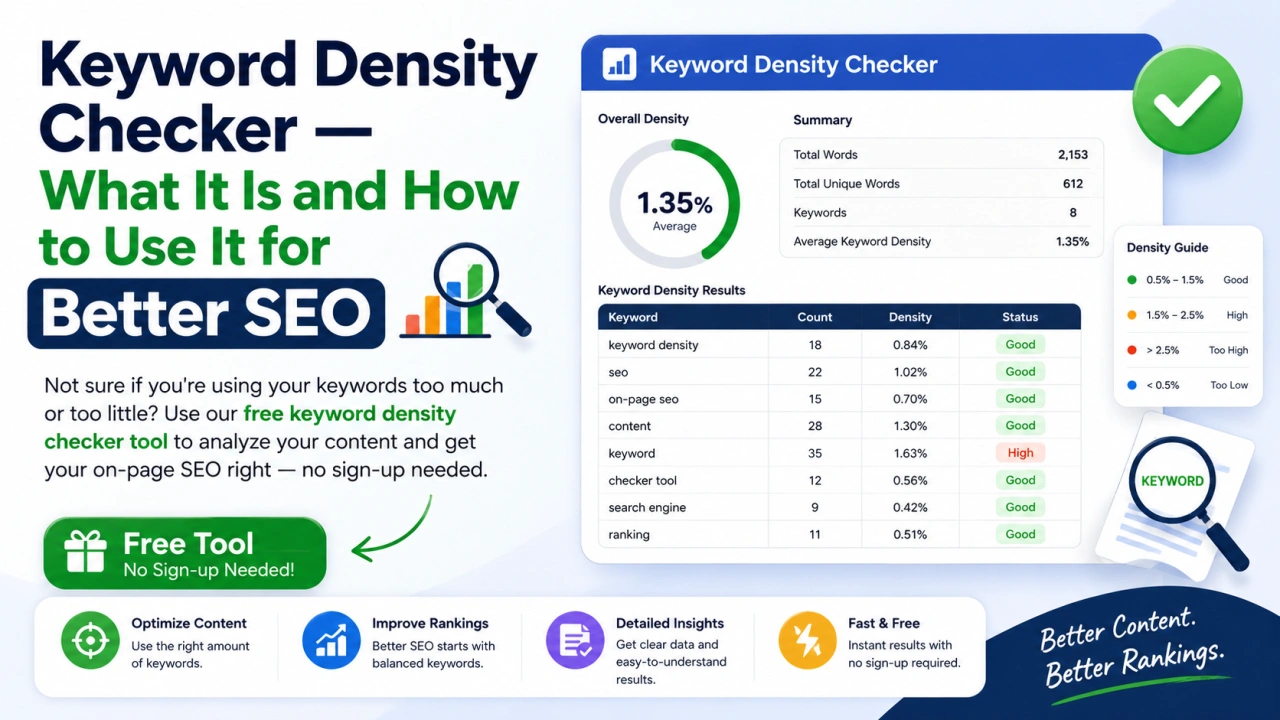
You've written a blog post. You've added your target keyword throughout the content. But now a nagging question sits in the back of your mind — have you used it too many times? Not enough? Is Google going to read this as helpful content or flag it as keyword stuffing?
This is one of the most common on-page SEO questions writers, bloggers, and content marketers face — and it's one that's easy to answer once you understand what keyword density actually means and how to check it properly.
In this guide, we'll explain keyword density in plain English, tell you exactly what percentage to aim for, and show you how to use a free keyword density checker tool to analyze your content in seconds.
What Is Keyword Density?
Keyword density is the percentage of times a specific keyword or phrase appears in your content compared to the total number of words on the page.
The formula is simple:
Keyword Density (%) = (Number of times keyword appears ÷ Total word count) × 100
For example: if your blog post is 1,000 words long and your target keyword appears 10 times, your keyword density is 1%.
That's it. No complicated maths — just a straightforward ratio that tells you how prominent a keyword is within your content.
Why Does Keyword Density Matter for SEO?
Search engines like Google analyze the words on your page to understand what it's about. The keywords you use — and how often you use them — are one of the signals Google uses to match your page to relevant searches.
But here's where most people get it wrong: more is not better.
In the early days of SEO, website owners would stuff their pages with keywords as many times as possible to rank higher. A page about "cheap flights to London" might repeat that phrase 50 times in 500 words. It looked terrible to human readers but temporarily worked with older search algorithms.
Google caught on. Its Panda and later Helpful Content updates specifically target keyword-stuffed, low-quality pages and push them down in rankings. Today, over-optimizing with keywords can actively harm your rankings — not help them.
Keyword density matters because it needs to be in a specific range — high enough for Google to understand your topic, low enough to read naturally for your human audience.
What Is the Ideal Keyword Density Percentage?
There is no single magic number, and anyone who tells you there is one is oversimplifying. However, based on consistent analysis of top-ranking content across competitive niches, the general guidance is:
- 1% to 2% is considered the safe, optimal range for most content
- Below 0.5% may mean the keyword is too sparse — Google might not clearly understand the page's primary topic
- Above 3% starts to look unnatural and risks being flagged as over-optimized
For a 1,000-word article, that means your primary keyword should appear roughly 10 to 20 times — including in your title, headings, opening paragraph, body content, and closing section.
For longer content of 2,000 words, you're looking at 20 to 40 instances while still keeping the writing natural and readable.
The most important rule: if your content reads naturally to a human, you're probably in the right range. If it sounds repetitive and forced, it almost certainly is.
Keyword Density vs Keyword Prominence vs Keyword Frequency
These three terms get mixed up constantly. Here's the clear difference:
Keyword Frequency is simply the raw count — how many times does the keyword appear on the page. If your keyword appears 15 times, the frequency is 15.
Keyword Density is the percentage — frequency as a proportion of total words. 15 appearances in 1,000 words = 1.5% density.
Keyword Prominence refers to where on the page the keyword appears. Google gives more weight to keywords that appear early — in your title tag, H1 heading, opening paragraph, and first few subheadings. A keyword appearing in these prominent positions signals its importance more strongly than the same keyword buried at the bottom of a long article.
For proper on-page SEO, you need to think about all three. Use your keyword at the right density, but also make sure it appears prominently — early, in headings, and in your meta title and description.
What Is Keyword Stuffing and Why You Must Avoid It?
Keyword stuffing is the practice of overloading a page with keywords in an attempt to manipulate search rankings. It makes content unreadable and is a direct violation of Google's Webmaster Guidelines.
Examples of keyword stuffing:
- Repeating a keyword in every sentence regardless of whether it fits naturally
- Adding long lists of keywords at the bottom of a page hidden in white text
- Filling image alt text with repeated keywords
- Using slight variations of the same phrase excessively ("best keyword density checker", "free keyword density checker tool", "keyword density checker online" all crammed into one paragraph repeatedly)
Google's algorithm is sophisticated enough to detect all of these tactics. Pages caught keyword stuffing typically see significant ranking drops — and in serious cases, manual penalties.
The fix is simple: write for people first. Use your keyword where it makes sense and reads naturally. Let the density fall where it falls, then check it with a tool to make sure you're within range.
How to Use a Keyword Density Checker Tool
Manually counting every keyword occurrence across a 1,500-word article is impractical. That's exactly what a keyword density checker tool is for.
Here's how to use ours at The Infinite Insights in three steps:
Step 1 — Paste your content Copy the full text of your blog post, article, or web page and paste it into the text field on the tool. You can also enter a URL if the page is already published.
Step 2 — Click Analyze The tool instantly processes your content and calculates the frequency and density percentage for every keyword that appears in your text.
Step 3 — Review and adjust Look at your primary target keyword first. Is it between 1% and 2%? Check your secondary keywords too. If anything is significantly over 2.5%, rewrite a few of those instances using natural synonyms or related phrases.
Use the Free Keyword Density Checker Tool Here →
The tool filters out common stop words like "the", "is", "and", "a" — so you're only looking at meaningful keyword data, not noise.
How to Fix Keyword Density Issues
If your density is too low (below 0.5%):
- Add the keyword naturally to your introduction if it isn't already there
- Include it in at least one subheading
- Mention it in your conclusion
- Check that you haven't accidentally used too many synonyms — some variation is good, but your primary keyword should still appear clearly
If your density is too high (above 2.5%):
- Replace some instances with natural synonyms or related phrases
- Restructure sentences where the keyword feels forced
- Remove keyword appearances from places where they add no value — captions, repeated headers, unnecessary mentions in body paragraphs
- Read the content aloud — anywhere it sounds awkward is probably a keyword that needs replacing
LSI Keywords — The Smart Way to Supplement Your Primary Keyword
LSI stands for Latent Semantic Indexing — a method search engines use to understand the relationship between words and topics. In practical terms, it means Google doesn't just look for your exact keyword — it looks for related terms that confirm the page's topic.
If your primary keyword is "keyword density checker", Google also expects to see related terms like:
- keyword frequency
- SEO content analysis
- on-page optimization
- keyword stuffing
- search engine optimization
- content audit
Including these naturally throughout your content helps Google understand the full context of your page — which typically leads to better rankings than repeating the same exact keyword phrase over and over.
A keyword density checker tool can help you spot if you're relying too heavily on one phrase. If you are, replace some instances with these related terms.
Keyword Density for Different Types of Content
Different content types have slightly different best practices:
Blog posts and articles (500–2,500 words): Aim for 1–2% for your primary keyword. Include 3–5 related secondary keywords at lower densities.
Product pages: Keyword density is slightly less critical here. Focus on prominence — keyword in the product title, first paragraph, and key feature descriptions.
Landing pages: Keep primary keyword density around 1–1.5%. Landing pages tend to be shorter, so every instance counts more.
Long-form guides (2,500+ words): You have more room for natural keyword variation. Density may naturally fall closer to 0.8–1.5% — which is perfectly fine at this length.
Common Keyword Density Mistakes to Avoid
Mistake 1 — Optimizing for density alone Keyword density is one signal among hundreds. Don't spend hours perfecting your 1.3% density while ignoring page speed, backlinks, user experience, and content quality.
Mistake 2 — Targeting only one keyword Modern SEO content should target a primary keyword and several related secondary keywords. A page ranking for one keyword when it could rank for ten is leaving traffic on the table.
Mistake 3 — Checking density before the draft is finished Write your content naturally first. Then check density at the end and make minor adjustments. Checking mid-draft leads to unnatural, keyword-forced writing.
Mistake 4 — Ignoring keyword placement A keyword appearing once in your title and H1 heading is more valuable than the same keyword appearing three times in your footer. Placement matters as much as count.
Final Thoughts
Keyword density is not a ranking magic trick — it's a hygiene check. It tells you whether your content is in a natural, reasonable range for the keywords you're targeting. Too low and Google may not fully understand your topic. Too high and you risk being penalised for over-optimization.
The goal is always content that reads naturally and helpfully for a human reader. Use a keyword density checker as a final sanity check before publishing, not as a tool to engineer your writing around.
Check your next piece of content with our free tool — no sign-up required, results in seconds.
Try the Free Keyword Density Checker →
Related tools you might find useful:

The Editorial Team
We are a collective of tech enthusiasts and digital experts dedicated to making sense of the evolving digital landscape for our global audience.
Connect With Us

0 Perspectives