You've spent hours writing your blog post. You've added your target keyword in the title, the intro, the headings, and throughout the body. But somewhere along the way, a question creeps in — have you gone too far? Is this helpful content, or have you accidentally crossed into keyword stuffing territory?
It's a fair concern. And it's one that trips up a lot of bloggers and content writers, especially those who are still learning the rules of SEO.
This guide explains exactly what keyword stuffing is, why it damages your Google rankings, how to spot it in your own content, and how to fix it — without stripping out the keywords that matter.
What Is Keyword Stuffing?
Keyword stuffing is the practice of loading a web page with a specific keyword or phrase so many times that it starts to feel unnatural — either to human readers or to search engine crawlers.
The intent behind it is usually to rank higher in Google by repeating a keyword as many times as possible. The logic being: if Google sees your page mention "cheap flights to London" thirty times, surely it'll rank you at the top for that search.
That logic stopped working around 2011. Today, it actively backfires.
Google's algorithms are sophisticated enough to detect when a page is over-stuffed with keywords. When they find it, the page typically drops in rankings — sometimes significantly. In serious cases, a site can receive a manual penalty that takes months to recover from.
What Does Keyword Stuffing Actually Look Like?
Here are real examples so you know exactly what to avoid:
Example 1 — Repetition in body text:
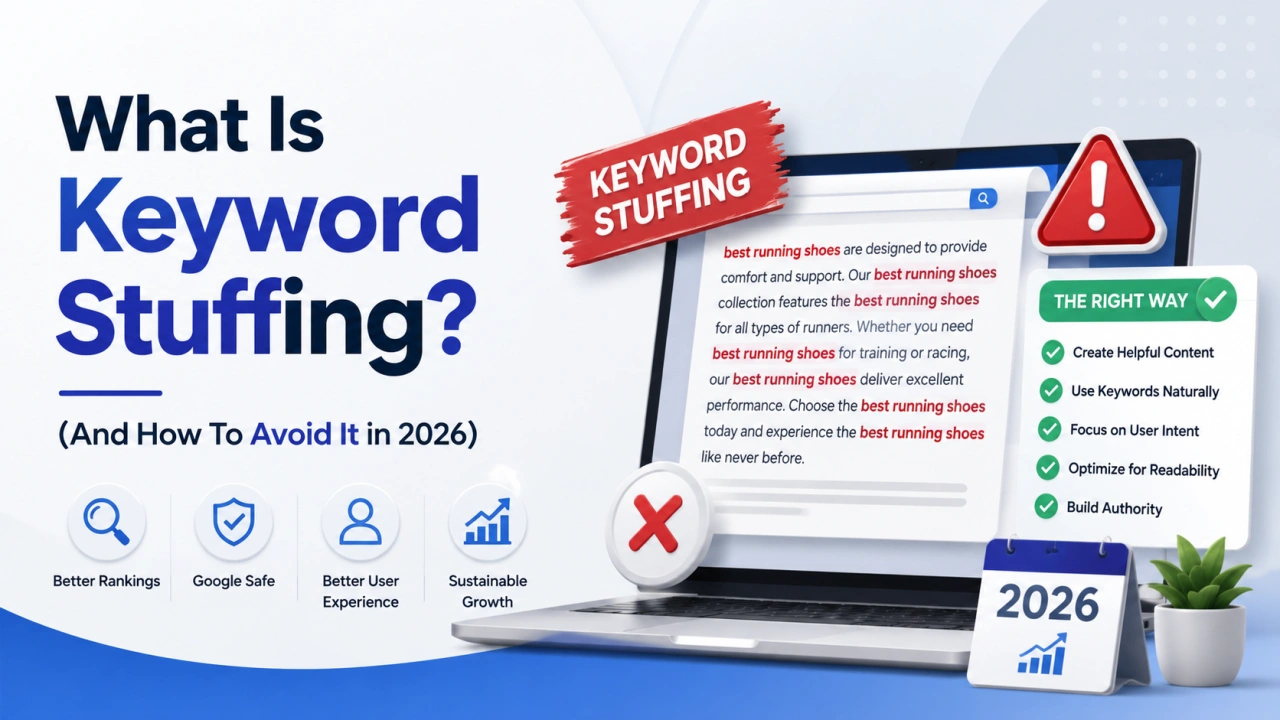
"If you are looking for the best running shoes, our best running shoes store has the best running shoes for men and women. Buy best running shoes today."
That reads horribly. No real person writes or talks like that. Google sees it immediately.
Example 2 — Hidden keywords: Some older websites used to add keywords in white text on a white background — invisible to readers but readable by search bots. Google has been detecting this since the early 2000s.
Example 3 — Irrelevant keyword lists: Adding a block of keywords at the bottom of a page — "cheap hotels, budget hotels, affordable hotels, low cost hotels, hotels near me, best hotels 2026" — with no surrounding content.
Example 4 — Stuffed alt text: Filling every image alt attribute with the same keyword phrase instead of describing what the image actually shows.
All of these tactics tell Google one thing: this page was built to manipulate search rankings, not to help readers.
Why Keyword Stuffing Hurts Your Rankings
Google's core mission is to serve useful, trustworthy content to searchers. Keyword-stuffed pages fail that mission on every level — they read unnaturally, they prioritise the algorithm over the reader, and they typically lack the depth and quality that genuinely helpful content has.
Starting with the Panda update in 2011, and continuing through to the Helpful Content updates of recent years, Google has consistently moved toward rewarding content that serves human readers first. Pages that stuff keywords tend to score poorly on readability, engagement, and user experience — all signals Google uses to assess quality.
The result: keyword stuffing no longer helps you rank. It hurts you.
How Much Is Too Much? Understanding Keyword Density
The clearest way to know whether you've crossed into keyword stuffing territory is to check your keyword density — the percentage of times a keyword appears relative to your total word count.
The general guidance from SEO professionals is:
- 1% to 2% is the healthy range for a primary keyword
- Above 3% starts to look unnatural and risks over-optimisation flags
- Below 0.5% may mean the keyword isn't prominent enough
For a 1,000-word article, that means your main keyword should appear roughly 10 to 15 times — including in your title, opening paragraph, a subheading or two, and naturally throughout the body.
The fastest way to check where your content stands is to use a free keyword density checker. Paste your text in, hit analyse, and you'll see exactly which keywords are appearing too often — in seconds, without any guesswork.
Check your content now with our free Keyword Density Checker →
No sign-up needed. Results in under 30 seconds.
How To Write Naturally Without Stuffing Keywords
The good news is that fixing keyword stuffing — or avoiding it entirely — isn't complicated. It comes down to writing like a human being.
Use synonyms and related phrases. Instead of repeating "best running shoes" ten times, use "top trainers", "running footwear", "quality athletic shoes". Google understands these are all the same topic. Your content reads better, and you cover more related search terms at the same time.
Write your draft first, optimise second. Don't think about keyword density while you're writing. Get your ideas down naturally. Then, once the draft is finished, run it through a keyword density checker and make minor adjustments if needed. This approach produces far more readable content than trying to engineer keyword counts as you write.
Read it aloud. This is one of the most underrated editing techniques. If a sentence sounds awkward when spoken, it probably has a keyword problem. Natural writing flows smoothly. Stuffed writing stumbles.
Focus on topics, not keywords. Modern SEO rewards content that thoroughly covers a topic — not content that repeats one phrase endlessly. Think about all the questions your reader might have, and answer them fully. The keyword will appear naturally as a result.
How To Fix Keyword Stuffing in Existing Content
If you've run your content through a keyword density checker and found your primary keyword is sitting above 3%, here's how to bring it back into range:
Step 1 — Identify the exact keyword that's over-used. Your keyword density checker results will show you each word and its percentage. Look for anything primary above 2.5%.
Step 2 — Find every instance in your content. Use Ctrl+F (or Cmd+F on Mac) to highlight every occurrence of the phrase.
Step 3 — Replace roughly one in three instances. You don't need to remove the keyword entirely — just thin it out. Replace some instances with synonyms, related terms, or restructured sentences that make the same point differently.
Step 4 — Re-check. Paste the updated content back into the keyword density checker and confirm the density has dropped to a natural range.
Step 5 — Read through once more. Make sure the edits haven't disrupted the flow of the content. It should read smoothly from start to finish.
A Note on LSI Keywords and Semantic SEO
One of the most effective ways to avoid keyword stuffing while still signalling your topic clearly to Google is to use LSI keywords — Latent Semantic Indexing terms that are naturally related to your main topic.
If your primary keyword is "keyword stuffing", Google also expects to see terms like:
- over-optimisation
- keyword density
- Google Panda
- content quality
- on-page SEO
- search rankings
Including these terms naturally throughout your content helps Google understand the full depth of your page — which typically produces better rankings than repeating the same exact phrase over and over.
Common Keyword Stuffing Mistakes Bloggers Make in 2026
Stuffing the meta description. Some writers pack their meta description with keywords thinking it helps rankings. It doesn't — Google ignores the meta description for ranking purposes. Write it for human readers who see it in search results.
Repeating the keyword in every heading. Your H2 and H3 headings should describe the section content — not repeat your target keyword five times across five headings.
Over-using the keyword in image alt text. Every image alt text should describe what the image shows. One relevant keyword mention per image is fine. Repeating the same phrase across every alt tag on the page is not.
Using keyword variations as if they're different keywords. "Keyword stuffing", "keyword stuffing SEO", and "what is keyword stuffing" are variations of the same topic. Treat them as one keyword in your density calculations.
Final Thoughts
Keyword stuffing is one of those SEO mistakes that feels logical on the surface — more keywords should mean better rankings, right? In practice, the opposite is true. Google's job is to find the best content for its users, and stuffed pages simply aren't that.
Write clearly, write helpfully, and let your keyword density fall naturally into a healthy range. Use a tool to check it before you publish, make minor adjustments where needed, and then focus your energy on what actually moves the needle: useful content, good structure, and genuine value for your reader.
That's what ranks in 2026. That's what always will.
Want to check if your content is already in the safe zone? Run it through our free tool — no account needed.

The Editorial Team
We are a collective of tech enthusiasts and digital experts dedicated to making sense of the evolving digital landscape for our global audience.
Connect With Us

0 Perspectives