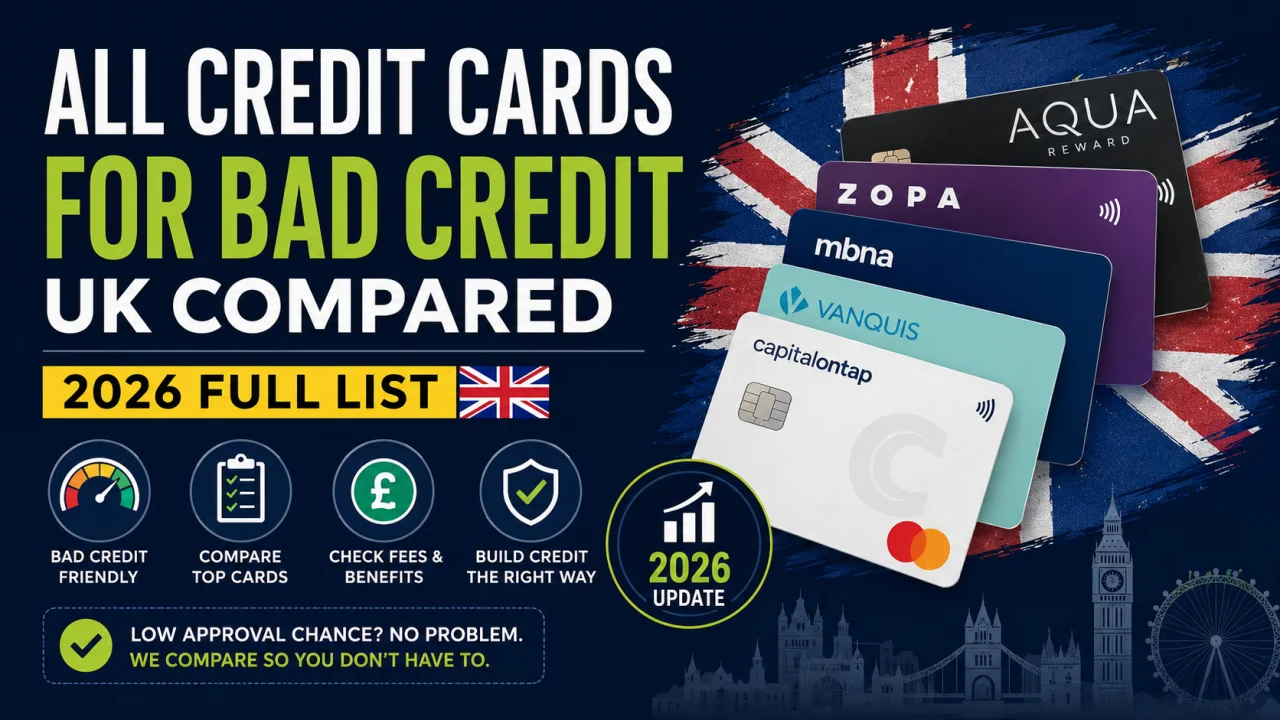
Most "best credit cards for bad credit" articles show you five picks and call it a day. That's useful if you already know what type of card you need — but if you're starting from zero, it skips the more important question: what categories of bad credit card actually exist, and which one fits your situation?
This is the fuller picture: every major type of bad credit card available in the UK right now, If you want specific card recommendations rather than categories, our best credit cards for bad credit in the UK for 2026 picks six standout options with full pros and cons. compared on APR range, typical credit limit, fees, and who each one actually suits.
The Categories, Side by Side
| Card Type | Typical Representative APR | Typical Starting Limit | Annual Fee | Best For |
|---|---|---|---|---|
| Credit-builder cards | 29.9% – 39.9% | £250 – £1,200 | Usually none | Rebuilding after missed payments or defaults |
| Secured / deposit-backed cards | 19.9% – 29.9% | Equal to deposit | Sometimes | Those who can put down a refundable deposit |
| Basic bank current account cards | 24.9% – 34.9% | £200 – £500 | None | Existing customers of a bank with in-house options |
| Store cards | 25% – 35% | £150 – £600 | None | Single-retailer spending, not general use |
| Prepaid cards (not real credit) | N/A | Load your own funds | Sometimes | Budgeting only — does not build credit history |
| Guarantor-backed products | Varies | Higher, based on guarantor | Sometimes | Applicants who have a family member willing to co-sign |
APRs and limits vary by provider and individual circumstances — always check the representative example on the lender's own page before applying.
Credit-Builder Cards
These are the most common recommendation for bad credit, and for good reason. They're built specifically to accept applicants who've been declined elsewhere, report to all three UK credit reference agencies, and usually start with a low limit that increases with good repayment behaviour.
Trade-off: APRs sit at the higher end of the market. These are often the cards advertised with "guaranteed approval" language — worth reading what that claim actually means before applying anywhere. These cards only make financial sense if you clear the balance in full every month — carrying a balance at 35%+ APR gets expensive fast.
Secured / Deposit-Backed Cards
Less common in the UK than the US, but available from a handful of providers. You place a refundable deposit (often £200–£1,000) which becomes your credit limit. Because the lender's risk is covered by your own money, approval odds are high and APRs tend to be lower than unsecured credit-builder cards.
Trade-off: You need the cash for the deposit upfront, which isn't realistic for everyone rebuilding credit.
Basic Bank Current Account Cards
If you already bank with a major UK provider, ask about in-house credit cards for existing customers. Banks sometimes approve customers with a strong current account history even when their credit file looks patchy, because they already have visibility into your income and spending.
Trade-off: Not available to everyone — usually requires an existing, well-run current account with the same bank for several months first.
Store Cards
Retail store cards are often easier to get approved for than general-purpose credit cards because the risk to the retailer is capped by where you can spend. They can be a legitimate first step for building credit history.
Trade-off: High APRs, limited to spending at one retailer, and easy to accumulate debt on impulse purchases.
Prepaid Cards
Worth naming because they're frequently marketed alongside "bad credit" cards, but they are not credit products. You load your own money onto them — there's no borrowing, no interest, and critically, no credit history built, since there's no lending involved to report.
Use case: Budgeting and spending control, not credit repair.
Guarantor-Backed Cards and Loans
A small number of products allow a guarantor (usually a family member with good credit) to back your application. This can unlock better rates and higher limits than you'd qualify for alone.
Trade-off: Your guarantor becomes liable if you miss payments — a decision that affects them, not just you.
How to Choose Between These
Ask yourself three questions:
- Can I pay the balance off in full each month? If yes, a credit-builder card's high APR barely matters, since you won't be charged interest. If no, prioritise the lowest APR you can get approved for — a secured card is often the better fit.
- Do I have a deposit I can lock away for a few months? If yes, secured cards typically offer better terms than unsecured credit-builder cards.
- Am I an existing customer of a bank with a solid track record there? If yes, check their in-house options before applying elsewhere — you may skip a hard search altogether with a pre-approval.
Still want named picks once you've settled on a category? Check our best credit cards for bad credit UK 2026 for specific recommendations in each category.
What to Check Before Applying to Any of Them
- Does the card report to Experian, Equifax, and TransUnion? If it doesn't report to all three, it won't help as much as it should.
- Is there a soft-search eligibility checker? Use it before applying anywhere.
- What's the representative APR, and is it based on 51% of successful applicants (the FCA-required standard) or just a headline rate?
- Are there monthly or annual fees on top of interest?
The Bottom Line
There's no single "best" bad credit card — there's a best category for your specific situation. If you can clear your balance monthly, a credit-builder card is usually the simplest path. If you're carrying a balance, a secured card will save you money in interest. Compare within the right category, not just across headline offers.
Frequently Asked Questions
Q: What's the difference between a credit-builder card and a secured card? A credit-builder card is unsecured — no deposit required — but usually comes with a higher APR. A secured card requires a refundable deposit that becomes your credit limit, and typically offers a lower APR because the lender's risk is covered.
Q: Do prepaid cards help build credit in the UK? No. Prepaid cards involve no borrowing, so there's nothing for the provider to report to credit reference agencies. They're useful for budgeting, not credit repair.
Q: How many bad credit cards should I apply for at once? One at a time. Multiple hard searches in a short window can lower your score further and make future applications harder. Use soft-search eligibility checkers to narrow down your choice before applying.
Q: Can a guarantor card get me a better rate than a standard bad credit card? Often yes, because the lender's risk is reduced by the guarantor's creditworthiness. The trade-off is that your guarantor takes on legal responsibility for the debt if you can't pay.
Q: Will my credit limit increase automatically over time? With most credit-builder cards, yes — providers typically review your account every few months and increase your limit if you've paid on time and kept your balance low. It isn't guaranteed and varies by provider.
Q: Is a store card a good first credit card for bad credit? It can be, since approval odds are often high and it can help build a payment history. The downside is a typically high APR and spending restricted to one retailer, so it works best if you'd shop there anyway and can pay in full each month.

The Editorial Team
We are a collective of tech enthusiasts and digital experts dedicated to making sense of the evolving digital landscape for our global audience.
Connect With Us

0 Perspectives