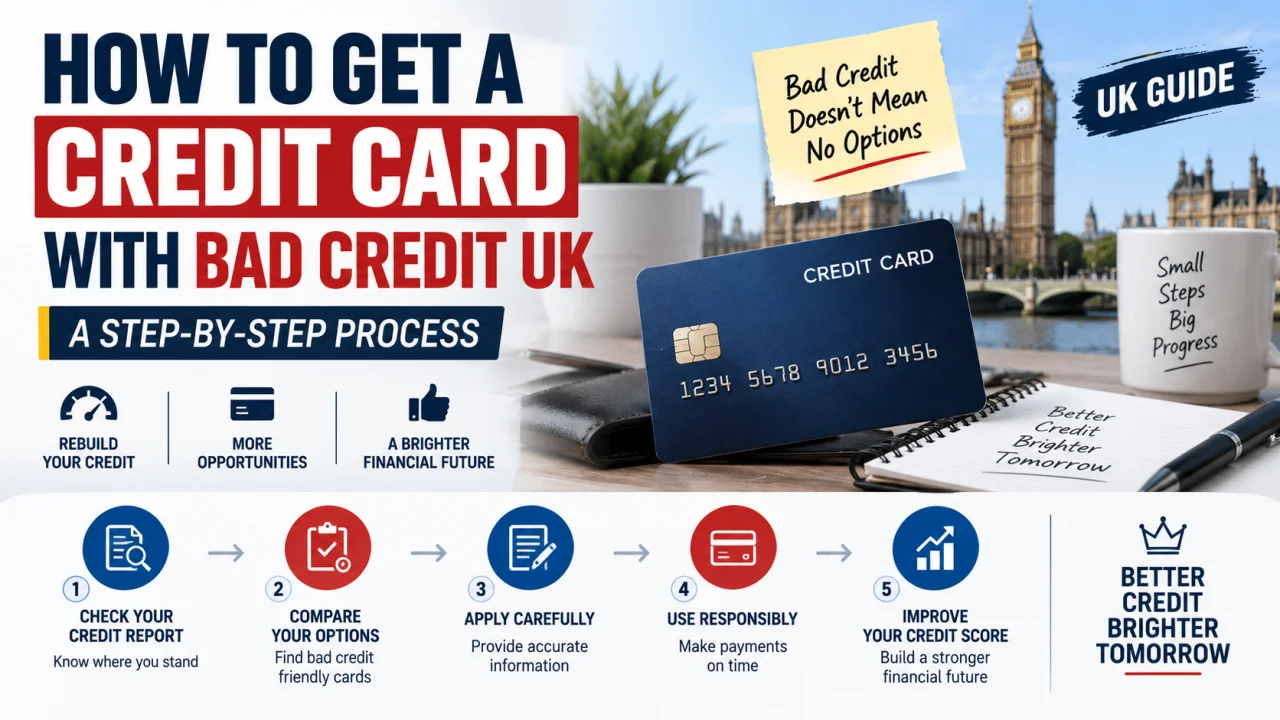
If you've been declined before, applying for another credit card can feel like a gamble you're not sure is worth taking. Every hard search leaves a mark, and another rejection can push your score down further at the exact moment you're trying to build it back up.
The good news is that getting approved with bad credit in the UK is genuinely achievable — but it works far better as a deliberate process than a hopeful application. This is that process, step by step, from checking where you stand to actually using the card once you're approved.
If you're still deciding which type of card or specific provider fits you best, our guides on the best credit cards for bad credit in the UK and every bad credit card category compared cover that side in detail. This guide focuses purely on the application process itself — what to do, in what order, to maximise your odds of a yes.
Step 1: Check Your Credit Report Before Doing Anything Else
Before you apply anywhere, get a clear picture of what lenders will actually see. All three UK credit reference agencies — Experian, Equifax, and TransUnion — offer free access to your report.
What to look for:
- Errors or accounts you don't recognise. Incorrect defaults, accounts opened fraudulently in your name, or payments marked late that weren't. Disputing and correcting these can improve your score before you even apply.
- Which agency shows the strongest file. Because lenders check different agencies, you may qualify more easily with a lender that checks the agency where your file looks best.
- Whether you're on the electoral roll. This is one of the most common, most fixable reasons for automatic declines. If you're not registered at your current address, do this first — it can take a few weeks to reflect on your file.
Step 2: Understand Why You Were Declined Before (If You Were)
If you've applied and been rejected previously, the specific reason matters for what you do next. Common reasons include:
- Missed payments or defaults on your file
- A County Court Judgement (CCJ)
- Too many recent credit applications (multiple hard searches in a short window)
- Insufficient income relative to existing debt
- Being off the electoral roll
- A thin file with barely any credit history at all
Different reasons call for different next steps. A thin file, for example, is fixed simply by time and a suitable first card. A recent CCJ may need you to specifically seek out lenders who work with more severe credit issues, rather than mainstream credit-builder cards that might still decline you.
Step 3: Use a Soft-Search Eligibility Checker Before Applying to Anything
This is the single most important habit in this entire process, and it's the step most people skip.
A soft-search eligibility check tells you your approval odds for a specific card without leaving any mark on your credit file. Only a formal application triggers a hard search, which is visible to other lenders and can lower your score slightly.
Most major UK credit-builder card providers offer this on their own website before you apply. Use it every time, for every card you're considering, before submitting a full application. Applying blind and hoping is how people end up with multiple hard searches and a lower score than when they started.
Step 4: Apply to One Card at a Time
Once your eligibility checker results point you toward a realistic option, apply to that one card — not three or four "just in case."
Each hard search stays on your file and is visible to future lenders. Several applications in a short window signals financial stress, even if your actual situation is stable, and can make your next application harder to approve, not easier.
If you're declined despite a favourable eligibility check, wait at least a few weeks before applying elsewhere, and use that time to check whether anything on your file changed or whether a different provider might be a better fit.
Step 5: Provide Accurate, Consistent Information on Your Application
Small inconsistencies between your application and what's on file can trigger automatic declines even when your credit history itself would otherwise pass. Before submitting:
- Confirm your name, date of birth, and address match exactly what's registered with the credit reference agencies
- Use your current address, and make sure you've been registered there long enough to show up on the electoral roll
- Be accurate about your income and existing financial commitments — lenders cross-check this, and inconsistencies are treated as a red flag, not a technicality
Step 6: If You're Declined, Understand Your Options Before Reapplying Immediately
Getting declined isn't the end of the process — but reapplying immediately to a similar card rarely works either. Instead:
- Request the specific reason for the decline. UK lenders are required to provide this if asked, and it tells you exactly what to fix.
- Consider a secured or deposit-backed card if available, since approval is largely guaranteed by the deposit itself rather than your credit history.
- Look into a guarantor-backed option if you have a family member with strong credit willing to co-sign, which can unlock approval where you wouldn't qualify alone.
- Wait and rebuild first. Sometimes the honest answer is that you need a few months of positive data — an on-time phone contract, rent reporting through a service like CreditLadder, or a free tool like Experian Boost — before reapplying.
Step 7: Once Approved, Use the Card in a Way That Actually Improves Your Score
Getting approved is only the beginning. How you use the card determines whether your credit genuinely improves:
- Make small, regular purchases rather than leaving the card unused
- Pay the full statement balance every month, ideally via direct debit, so you never miss a payment or pay interest
- Keep your balance below roughly 25-30% of your limit at any given time
- Avoid applying for further credit for at least six months to let your score respond to the new positive history
A Realistic Timeline to Expect
- Immediately: A new account and (if you did a hard search) a small, temporary dip in your score
- 3-6 months: Consistent on-time payments typically begin showing a modest, upward movement
- 6-12 months: More noticeable improvement, assuming perfect payment history and low utilisation throughout
- 12+ months: Meaningful, sustained improvement, often enough to qualify for better products than you could get today
There's no way to safely speed this up dramatically — but following this process in order gives you the best realistic odds of approval on your first or second attempt, rather than accumulating declines that make things harder.
The Bottom Line
Getting a credit card with bad credit in the UK isn't about luck — it's about sequencing: check your file, understand what's holding you back, use soft-search tools before applying anywhere, apply to one well-matched card at a time, and use it correctly once approved. Skipping the eligibility check step is the single most common, most avoidable mistake people make in this process.
Frequently Asked Questions
Q: Will checking my eligibility for a card affect my credit score? No, as long as it's specifically a soft-search eligibility checker, not a full application. Soft searches are invisible to other lenders and don't affect your score. Only a formal application triggers a hard search.
Q: How long should I wait between credit card applications? There's no fixed legal waiting period, but waiting at least a few weeks to a few months between applications is generally advisable, since multiple hard searches in a short window can lower your score and signal risk to lenders.
Q: Can I get a credit card with a CCJ on my file? It's possible, though options narrow depending on how recent and severe the CCJ is. Some lenders specifically work with applicants who have CCJs, while others will decline automatically — checking eligibility before applying is especially important in this situation.
Q: Does being off the electoral roll really affect approval? Yes, significantly. Lenders use the electoral roll to verify your identity and address, and being unregistered is a common, easily fixable reason for automatic declines that has nothing to do with your actual credit history.
Q: What should I do immediately after being declined? Request the specific reason for the decline from the lender, avoid immediately reapplying to a similar card, and address the underlying issue — whether that's an error on your file, being off the electoral roll, or simply needing more time to build a positive history.
Q: Is it better to apply for a secured card if I keep getting declined for unsecured ones? Often yes. Because a secured card's credit limit is backed by your own refundable deposit, approval odds are typically much higher than for unsecured credit-builder cards, making it a practical fallback if you've been declined more than once.

The Editorial Team
We are a collective of tech enthusiasts and digital experts dedicated to making sense of the evolving digital landscape for our global audience.
Connect With Us

0 Perspectives